
Ravens: secrets and mischief of the most charming birds
When things get dark, listen to ravens.

When things get really dark and I need a little boost, one of my favourite things to do is settle down with a packet of crisps and watch some raven footage. There are all kinds of charming animals that exist in the world, but for me, ravens win the prize.
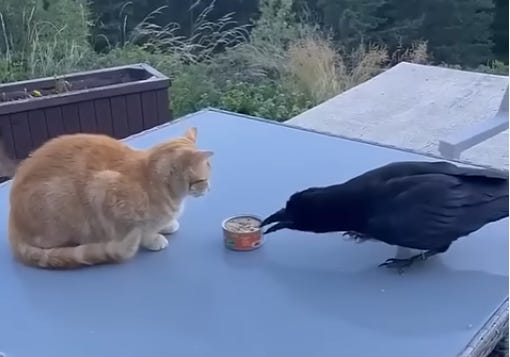
In this clip of noble theft, we see a raven stealing food from a cat. Why? The reason is surprising and delightful. Definitely worth the seventy one seconds it takes to watch.
There’s so much charm here. I love the tentative beak gestures followed by the over-confident ‘CAW’ which seems to say: ‘I’m taking this food, yeah? I’m taking it!’ A little aggression there, but when it comes to actually beaking away the tin of food, the raven seems furtive and coy.
Hilarious!
We’re only twenty seconds into the clip, and we’ve already seen more character dimension than some films offer in two hours.
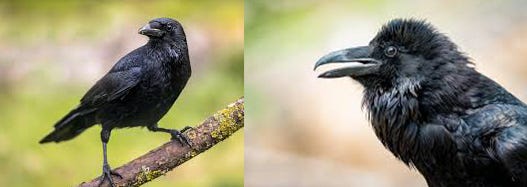
Here’s a crow, on the left, and a raven, on the right. Notice the charismatic beard feathers and the puffed up head ones. Ravens don’t always have these out, and can flatten them down to make themselves look more streamlined, like the one on the left, below.
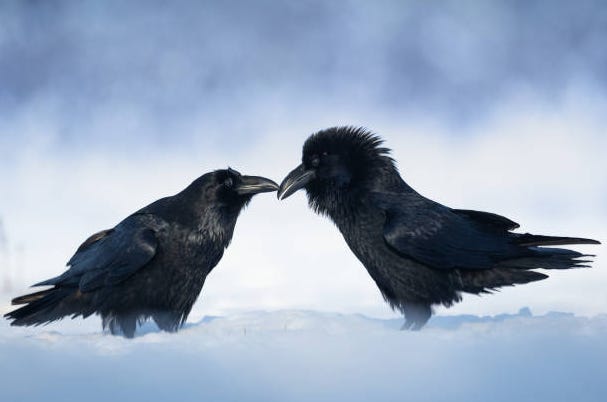
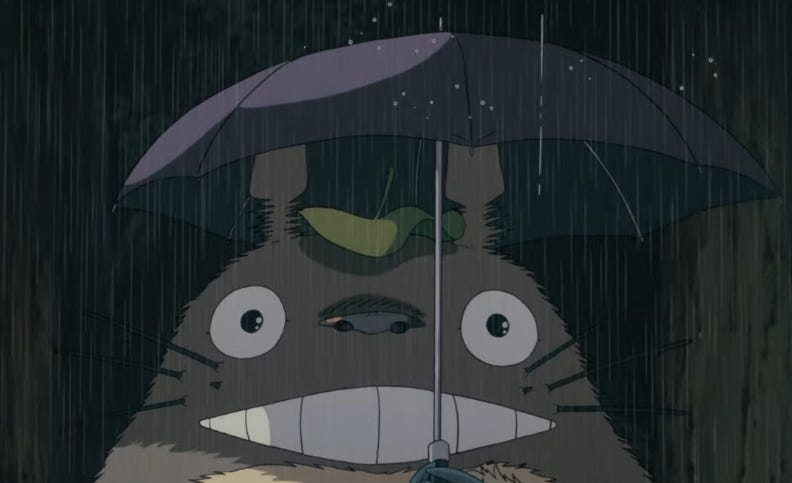
This fluffing-out of head feathers really changes their look. There are probably different reasons why they puff them out, but sometimes it seems like an involuntary display of inner excitement, like when raindrops fall on Totoro’s umbrella.
Other times it may just be to keep warm:
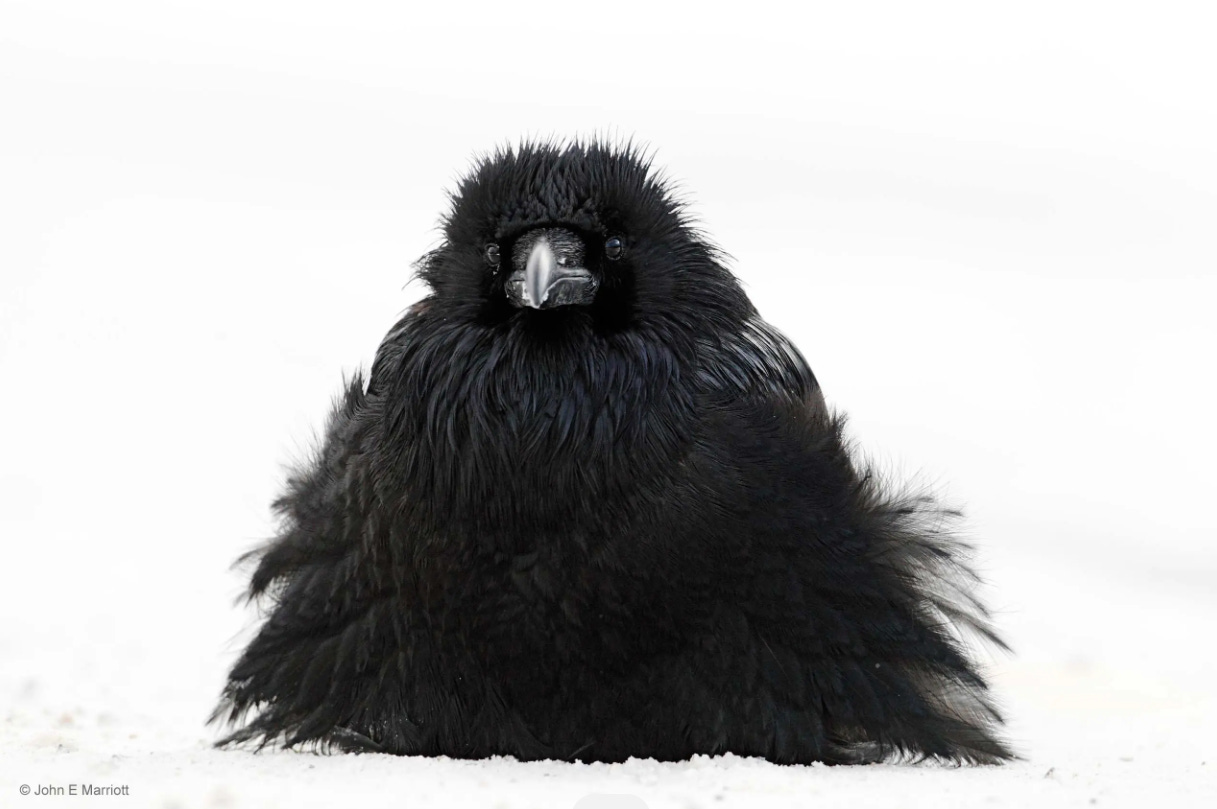
There is no question that ravens look awesome, but if I was pressed to yield up my single favourite quality then I’d probably say their voices.
Take a listen to these vocals, and feel the neglected pockets of darkness in your soul light up to the sound of raven calls.
Did you listen with headphones? In the one below you can actually hear the raven’s breath, which gives it a panting quality, like a dog.
As good as those field recordings are (thank you Mr Vlad), we’ve only just begun to scratch the surface of what ravens can do with their voices. This next clip not only features a talking raven, but a raven with a Yorkshire accent.
This particular raven, who I’m pretty sure is called Izabella, is one of the Knaresborough castle ravens, and has quite an amazing backstory, which you can read about here.
Janette Hustwitt, the woman in the video, acquired a single raven twenty seven years ago from a former Tower of London raven master. Having written a children’s story about a raven, she wanted to take both bird and book into local schools, but wasn’t allowed due to a lack of the correct public liability insurance.
No PLI, no ravens for children.
The story has various turns, and is definitely worthy of being the subject of a 10 part Netflix documentary series which someone should definitely make.
Here’s another Yorkshire accented raven - part of the same Knaresborough gang.
Being a Yorkshire man myself, I’ve heard this exact phrasing of ‘Y’alright love?’ uttered thousands of times. To hear a raven casually piping out these familiar words makes me laugh even more.
Raven stories
About sixteen years ago I came across an amazing book called Mind of the Raven: Investigations and Adventures with Wolf-Birds by the experimental biologist Bernd Heinrich. Two stories in particular have stayed with me.
This first was about a man who shared his house with a raven. Every morning he would order two copies of the same newspaper: one for him to read, the other for the raven to rip to shreds with its beak. If he didn’t do this, then the raven would get jealous of the man’s newspaper and wouldn’t let him read it, which I thought was hilarious.
The second was a study into raven communication where a small group of creative researchers loaded huge carcasses of meat with miniature, non-toxic, brightly coloured balls. Their hypothesis was that the juvenile ravens, in order to get an edge on the older, stronger, more savvy adults, would gather together in enormous roosts and share knowledge about the food they’d found. By measuring the number of coloured ball in their regurgitated pallets, the researchers were able to get an idea of how much the ravens were sharing knowledge about food bonanzas, by telling their mates through the medium of cronks, caws, and acrobatic display flights at pre-roost assembly areas.
(For those interested, you can read this short summary from the Journal of Animal Ecology). Here are some highlights:
‘Ravens feed on rich but ephemeral carcasses of large animals. Non-breeding juveniles forage socially and aggregate in communal winter roosts, which may function as ‘information centres’ regarding food locations.
Groups were led by a single bird roosting centrally within the aggregation. When individually identifiable (37·5% of cases), these individuals were dominant at the carcass and were among the minority of birds involved in acrobatic display flights at preroost gatherings.’
Newborough Forest is on the Isle of Anglesey, on the north-west coast of Wales; already a fascinating place to go even without these enormous gatherings of ravens. Some hold the island be the last strongholds of the druids against the invading Romans, which is an amazing even if partially true. I would have gone there anyway, but learning about these huge congregations of juvenile ravens doing acrobatic display flights and sharing knowledge in some kind of raven-moot, well how could I say no to that? Some people choose to spend their holidays in Tenerife or Majorca. I spent mine looking for ravens.
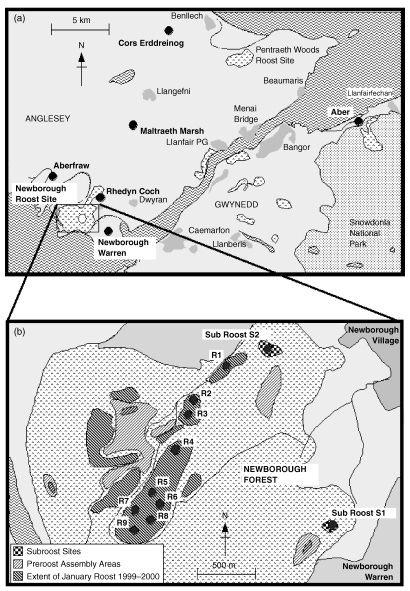
Here’s a map from the research paper. With nine raven roosts, two ‘sub roosts’ and some fairly large ‘pre-roost assembly areas’, you’d think it would have been easy to find those ravens, especially when there’s supposed to be well over a thousand of them in Winter, sometimes close to two thousand. But when I got there I couldn’t see or hear a single corvid.
My wife was resting with a cold at a nearby bed and breakfast, which meant I was by myself in those strangely quiet woods. A bank of mist was drifting in off the Irish Sea. It was cold, and dark, with nightfall about an hour away. I’m pretty comfortable wandering around in spooky forests, and even enjoy the experience of getting lost. Instead of being afraid, I usually find it enlivening. But that evening even the slightest sound sent a chill down my scalp. Was I welcome there, or not? How many people had died in centuries past, on the ground I was standing? Why in the world could I not find a single raven?
I’ve heard of Native Americans in certain tribes who won’t look directly at a river they’ve not seen before until they’ve been there more than a dozen a times. For them, the river is animate and alive, and just as you wouldn’t go overboard on eye-contact with a human you’d only just met, so too was it considered a sign of respect to not stare into the river’s face until some degree familiarity had been established. Well I’m not a Native American, but I remembered this story, and remembered as well that I hadn’t followed any kind of respectful protocol. I’d just wandered into this strange forest to look for ravens because I like them.
After wandering around in circles for more than hour, I started to think that these ravens were somehow pulling my leg. The study said this was one of the largest roosts in Europe, with over 1,500 ravens coming here reliably every winter. Surely I would have seen at least one. Had these trickster birds pulled a fast one on me? Or had I somehow gone to the wrong woods?
On that edge between dusk and night, with doubts flitting round me, a dark-feathered bird flew over the trees, then another. Was that a diamond-wedge tail? I changed direction and followed their flight path.
More came, zipping in from different directions. They were gathering in a clearing up the track to the north of the roost sites. I edged close, and listened.
Mixed in with the cronks and caws, were gong-like sounds, microwave pings, rattling noises and metallic clangs. As I lay there in the bushes, listening to this weird racket, I thought to myself: Those can’t all be raven sounds, can they?
The study had suggested they were sharing information about where they’d found food, but to me it sounded more like they were having a party, or doing some sort of acoustic joust where the strangest sound wins. The racket went on, full-force, for about four minutes, then died away as the ravens flew off to their roosts for bed.
It was a bizarre and special evening, and writing about it now makes me want to go back. Sometimes I’ll see ravens where I live in the North East of England, but not that many, and never for that long. When I want to see ravens, and hear their voices, most of the time I’ll just go online. Some of these raven videos have extraordinary numbers of views, and it’s even higher for other animals. If you add them up, we’re talking billions upon billions of views; vast spans of free time given over to watch animals on a screen.
In the background of all this we’re living through the sixth largest extinction period in the planet’s history (which I’m sure you’ve heard before).
Humans need the company of other animals, the company of the more-than-human world. In the UK, people keep as pets an estimated 1.5 million birds, 11 million cats, and 13 millions dogs. That’s more than a dozen times the entire human population of Patagonia.
We have a gargantuan pet industry, and an insatiable desire to watch animals on screens. Meanwhile, the mining of rare earth minerals to make those screens, the global supply chains needed to deliver them, and the vast amounts of energy required to sustain the Internet all contributes the destruction of habitats lived in by the animals we’re watching on our TVs and phones.
What happened to this post? It started off so fun. Now it’s got all heavy.
The heaviness of the times is half the reason I need to watch ravens stealing cat food, but when I do, this quote from Chief Seattle is never far from my mind:
‘If all the beasts were gone, man would die from a great loneliness of spirit, for whatever happens to the beasts also happens to the man.’
Ravens are trickster birds. They’re mischievous and playful, but not without pathos. They have to survive in a violent world, but they take the time to mess around and have fun.
Fantastic piece on such amazing birds. Kin for sure. Thank you. ❤️
Lovely videos! It is great ravens seem to be interested in us! (Probably not just for food)
I think our love of animals and birds and the environment means we are more connected to nature than we think! Thanks!